
Understanding how product reviews increase ecommerce conversion starts with a simple idea: shoppers trust other shoppers.
Reviews reduce uncertainty, provide social proof, and help customers decide whether a product is worth buying. PowerReviews research also shows that both review volume and review recency are strongly associated with higher buyer confidence and conversion.
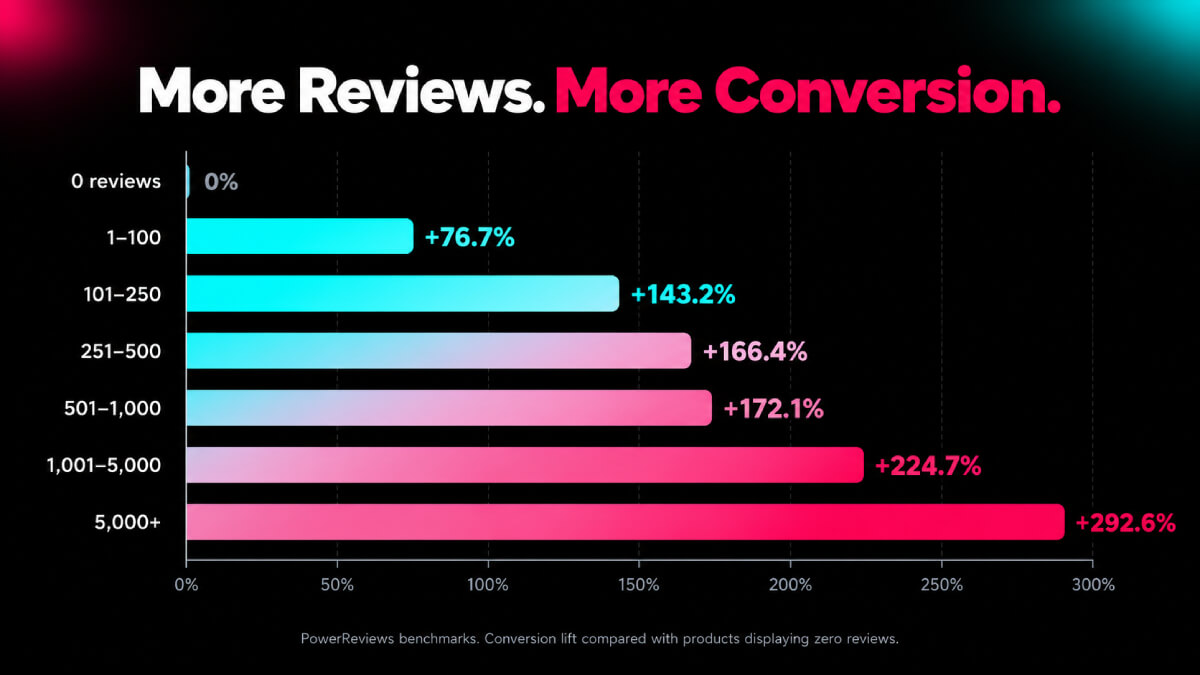
Products displaying 1 to 100 reviews were associated with a 76.7% conversion lift compared with products displaying no reviews. For products with 101 to 250 reviews, the lift increased to 143.2%.
The takeaway is not that one specific review suddenly changes conversion. It is that products with more credible, current customer feedback tend to perform better.
Product Reviews and Ecommerce Conversion: Key Takeaways
- 45% of consumers feel comfortable with 1–25 reviews.
- 26% need 26–50 reviews before they feel comfortable purchasing.
- 14% need 51–100 reviews.
- Products with 1 to 100 reviews were associated with a 76.7% conversion lift compared with products with none.
- Products with 101 to 250 reviews were associated with a 143.2% lift.
- 64% of consumers are more likely to buy a product with 1,000+ reviews than one with 100 reviews.
- 97% consider review recency at least somewhat important.
- Ratings and reviews influenced 94% of consumers, slightly more than product price at 91%.
- The strongest strategy combines review volume, review recency, and useful customer feedback.
How Product Reviews Increase Ecommerce Conversion
Product reviews help answer questions a product description cannot.
Shoppers want to know whether other customers bought the product, whether it met expectations, and whether the brand can be trusted.
That becomes even more important for unfamiliar products. PowerReviews found that 71% of consumers say review volume matters more when buying an unfamiliar brand or product, while 80% are less likely to purchase a product with no reviews.
The research also found that visitors who interacted with reviews converted at 7.6%, compared with an overall ecommerce visitor conversion rate of 3.4%.
That does not prove reviews alone caused the difference, since shoppers who read reviews may already have stronger purchase intent. But it reinforces how closely reviews are connected with the buying process.
Why Review Volume Matters
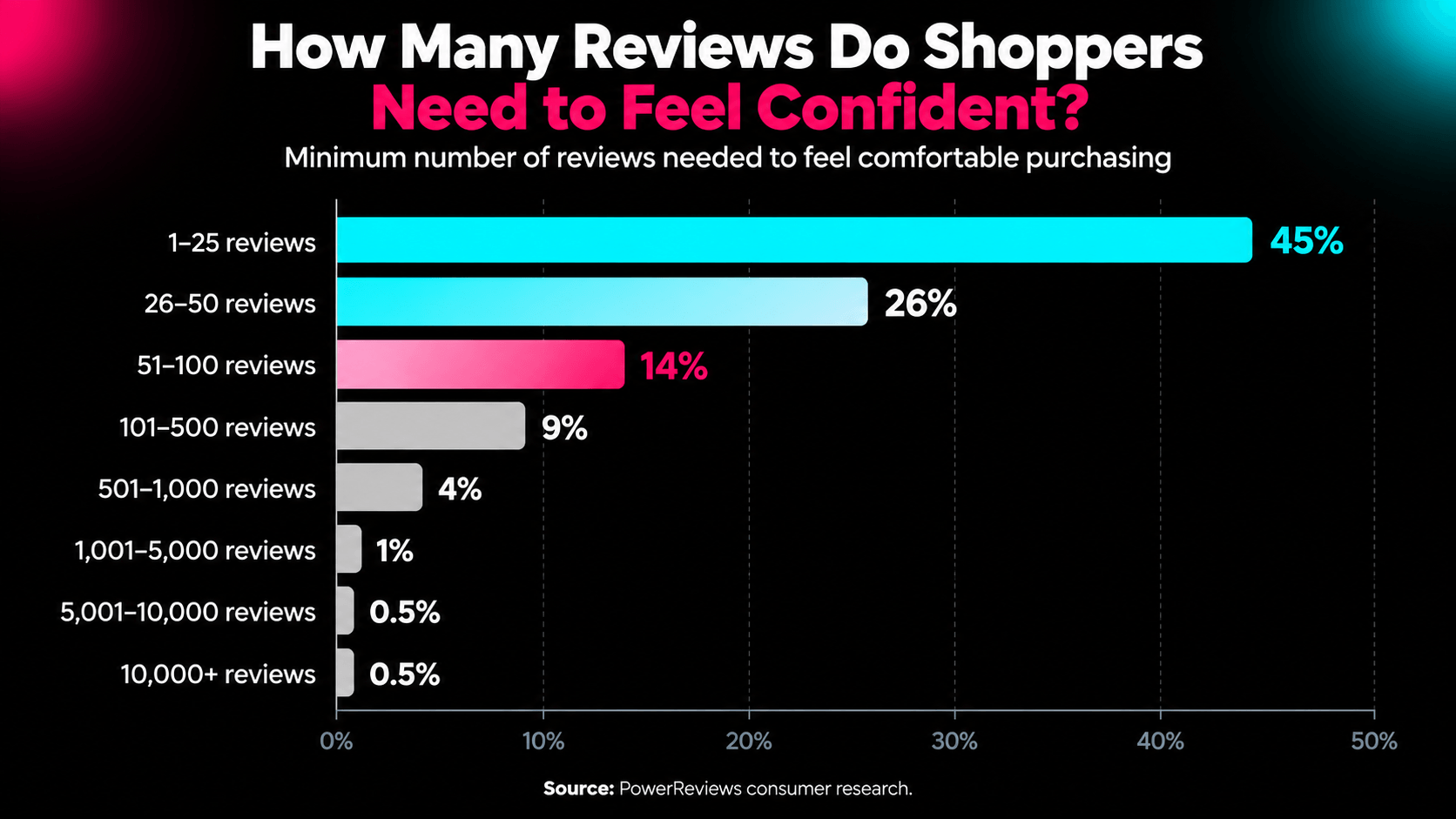
PowerReviews found that consumers vary in how many reviews they need before feeling comfortable purchasing a product.
The original response breakdown was:
- 1–25 reviews: 45%
- 26–50 reviews: 26%
- 51–100 reviews: 14%
- 101–500 reviews: 9%
- 501–1,000 reviews: 4%
- 1,001–5,000 reviews: 1%
- 5,001–10,000 reviews: 0.5%
- 10,000+ reviews: 0.5%
That means 55% of consumers need more than 25 reviews, and 15% need more than 100 reviews.
For brands, this means 25 reviews should be viewed as a starting point rather than an end goal.
Review Volume Continues to Matter Beyond 100 Reviews
The impact of review volume does not appear to stop once a product reaches 100 reviews.
PowerReviews found that 64% of consumers are more likely to purchase a product with 1,000+ reviews than one with 100 reviews.
Even at higher levels, the effect continues. 54% were more likely to purchase a product with 10,000+ reviews than one with 1,000 reviews.
The point is not that every product needs thousands of reviews.
It is that review volume continues building social proof after basic credibility has already been established.
Why Review Recency Matters
A large review count is valuable, but old reviews can lose some of their persuasive power.
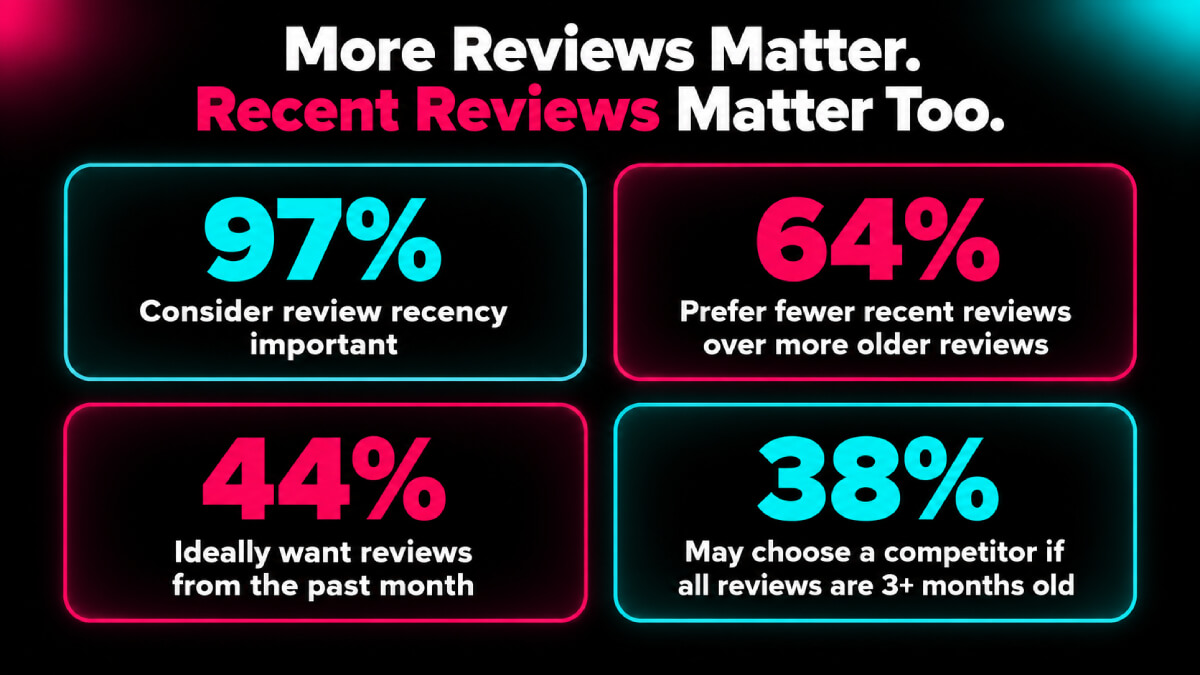
PowerReviews found that 97% of consumers consider review recency at least somewhat important.
It also found:
- 64% prefer fewer recent reviews over more reviews older than three months
- 44% ideally want reviews written within the previous month
- 38% may choose a competitor if all reviews are three months old or older
- 62% may not purchase if all reviews are one year old or older
This is why brands should not simply build up reviews once and stop.
The goal should be ongoing review velocity.
New reviews reassure shoppers that customers are still actively buying and using the product today.
Review Quality Matters Too
Review volume and review recency are important, but the content of those reviews matters as well.
PowerReviews found that reviews containing 500 or more characters had the greatest conversion impact in its analysis.
Customer imagery and useful review content also performed strongly. Shoppers often want more than a star rating. They want details about what happened when someone actually used the product.
That means brands should encourage customers to leave:
- Detailed product experiences
- Customer photos
- Specific pros and cons
- Current feedback
- Honest opinions
Even lower-rated reviews can add credibility by making the overall review profile feel more realistic.
The goal should be useful, authentic reviews, not simply perfect ratings.
Why Reviews Matter on TikTok Shop
TikTok Shop frequently introduces customers to brands and products they have never seen before.
A creator may spark interest, but when a shopper reaches the product listing, reviews help answer the next question:
“Do real customers trust this product?”
Creator content can create discovery. The product listing explains the offer. Ratings and reviews provide additional social proof before the customer checks out.
The PowerReviews data in this article comes from broader ecommerce research rather than TikTok Shop-specific studies, so these conversion benchmarks should not be presented as TikTok Shop platform statistics.
However, the underlying principle is especially relevant to TikTok Shop: the less familiar a product is, the more important trust signals become.
Reviews Can Matter as Much as Price
Price is important, but shoppers do not make purchase decisions based on price alone.
PowerReviews found the following purchase influences:
- Ratings and reviews: 94%
- Product price: 91%
- Free shipping: 78%
- Brand: 65%
- Recommendations from friends and family: 60%
Reviews ranked slightly ahead of price.
That helps explain why simply lowering the price may not fix a conversion problem if shoppers still do not trust the product.
How Brands Should Improve Their Review Strategy
A strong customer review strategy should focus on four things:
- Build meaningful review volume. Twenty-five reviews is only a starting point for many shoppers.
- Continue beyond 100 reviews. Social proof can keep strengthening as review volume grows.
- Maintain review recency. Fresh reviews show customers that people are still actively buying the product.
- Encourage useful feedback. Detailed reviews and customer imagery give prospective buyers more information.
Brands should also make review collection part of the normal post-purchase process.
PowerReviews found that 73% of consumers need some form of incentive to motivate them to submit a review. Incentives can include product samples, discounts, early access, or loyalty points.
Any incentive should be properly disclosed and should never require customers to leave a positive review.
The Bottom Line: How Product Reviews Increase Ecommerce Conversion
The research does not point to one magic review number.
Instead, it shows why review volume and review recency work together to strengthen ecommerce conversion.
More reviews create more social proof. Recent reviews show that the product remains relevant. Detailed reviews give shoppers the information they need to make a decision.
For ecommerce brands, customer reviews should therefore be treated as an ongoing conversion asset rather than a milestone to complete once.
More reviews build confidence.
Recent reviews maintain confidence.
And stronger confidence can help turn more shoppers into customers.
Product Reviews FAQ
How do product reviews increase ecommerce conversion?
Product reviews reduce uncertainty and provide social proof from previous customers. PowerReviews found that products with higher review volume were strongly associated with higher ecommerce conversion than products displaying no reviews.
How many product reviews should a product have?
There is no universal ideal number. PowerReviews found that 45% of consumers feel comfortable with 1–25 reviews, while others need more. 26% need 26–50 reviews, 14% need 51–100 reviews, and 15% need more than 100 reviews. The takeaway is that review volume matters, and many products need more than a small handful of reviews to build buyer confidence.
Does review volume affect conversion?
Yes. Products displaying 1 to 100 reviews were associated with a 76.7% conversion lift compared with products displaying no reviews, while products with 101 to 250 reviews were associated with a 143.2% lift.
Why does review recency matter?
Recent reviews help shoppers understand whether current customers are still buying and having good experiences with a product. PowerReviews found that 97% of consumers consider review recency at least somewhat important.
Do product reviews matter on TikTok Shop?
Reviews can help TikTok Shop shoppers evaluate unfamiliar products after discovering them through creators or ads. The specific conversion benchmarks cited here come from broader ecommerce research, not TikTok Shop-specific data.
Sources and Methodology
Primary research referenced in this article comes from PowerReviews, including:
- The Power of Review Volume & Recency
- What’s the Right Volume of Reviews to Collect?
- Review Collection, 10 Metrics to Watch
- The Impact of Review Volume on Conversion: Is More Really Better?
The research included surveys of 9,012 U.S. consumers and e-commerce behavioral datasets covering millions of product pages and billions of page visits.
The conversion percentages cited throughout this article are observational benchmarks, not guaranteed causal outcomes. They should not be interpreted to mean that adding a specific number of reviews automatically produces a specific increase in sales or conversion.